Direct and Retrograde Motion
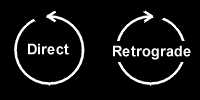
The words direct and retrograde can refer to different things depending on where the observer is. For an observer situated above the earth’s north celestial pole, direct motion is any counterclockwise motion, and retrograde motion is any clockwise motion. This can refer to the revolution of an object around the its primary or it can refer to the rotation of an object around its axis. All of the planets in the solar system have a direct revolution.
|
| Figure 1: The directions: direct and retrograde. |
For an observer on earth, direct motion is the apparent motion of a planet among the stars from west to east at the same time every night. Retrograde motion is the motion of a planet from east to west. When a superior planet approaches opposition, it appears to temporarily reverse directions, becoming retrograde for a short time before resuming a direct motion. This apparent motion can be in the form of a loop or a zigzag. The points where the planet reverses directions are called stationary points. This is illustrated in the following example.
 |
| Figure 2: The apparent direct and retrograde motion of a superior planet. The green planet is the earth, the red planet is any superior planet and the yellow curved line is the apparent path of the planet among the stars. The white lines are the lines of sight. |
If you do not see frames, click here to go to the frames page.
If you do not want to use frames, click here to go to the non-frames home page
and sitemap.