 |
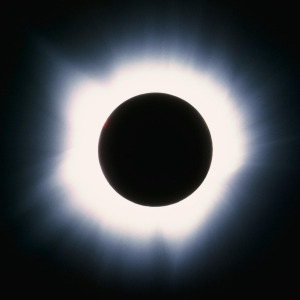
| Total Eclipse of the Sun: Copyright Association of Universities for Research in Astronomy Inc. (AURA), all rights reserved. |
Eclipses
|
| Total Eclipse of the Sun: Copyright Association of Universities for Research in Astronomy Inc. (AURA), all rights reserved. |
Eclipses come in two forms, solar and lunar.
Solar Eclipses
When the moon comes near a line between the sun and the earth, a solar eclipse occurs. A solar eclipse is when the moon covers all or part of the sun as seen from a point on earth. There are several types of solar eclipses. If the moon is near enough to the earth that it completely covers the sun, a total solar eclipse occurs. Total solar eclipses are rare. If the moon moves over the center of the sun, but is too far away from the earth to create a total solar eclipse, an annular eclipse occurs. Annular refers to the rim (annulus) of light seen around the moon during this type of eclipse. If the moon moves over a part of the sun but does not move over the center, a partial solar eclipse is seen. These three types of eclipses are illustrated below. This is not a completely accurate representation of eclipses because during a total eclipse the sun's corona (its atmosphere) can be seen more prominently than in this illustration.
 |
| Figure 1: The three different types of solar eclipses. From left to right: partial, annular, and total. The rim of white light around the total eclipse is the sun's corona. |
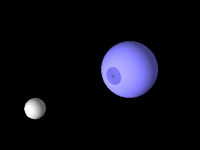
During an eclipse, there are areas on earth which experience a total eclipse, some areas which experience a partial eclipse, and some which experience no eclipse. Because of the motion of the moon and of the earth, during a total eclipse, the moon traces a path along the surface of the earth called the path of totality. Every point on earth on this path of totality will receive a total eclipse. Those near this path will only receive a partial eclipse.
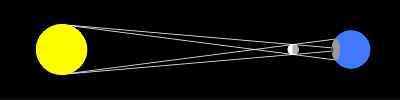
Because the sun is of a considerable size and not a pinpoint of light, an object in the solar system casts two shadows, one inside of the other. The inner shadow is called the umbra and is the region in which the object blocks out all light from the sun. The outer shadow is called the penumbra and is the region in which part of the sun is still partially visible. These two shadows are illustrated below.
|
| Figure 2: The umbra and penumbra. The umbra is the darker inner shadow, the penumbra is the lighter outer shadow. The bottom picture shows the path of the light rays from the sun. |
Only those in the path of the moon’s umbra receive a total eclipse. Those in the path of the penumbra receive a partial eclipse. When the moon is far enough away from the earth, as it is during an annular eclipse, only the penumbra reaches the surface and there is no total eclipse.
Lunar Eclipses
Eclipses also work the other way. A lunar eclipse occurs when the earth casts a shadow on the moon. When the whole moon passes within the earth’s umbra, a total lunar eclipse occurs. When only a portion of the moon passes within the earth’s umbra, a partial lunar eclipse occurs. When the moon passes only within the earth’s penumbra, a penumbral eclipse occurs. During this type of eclipse, only a slight darkening of the moon’s surface takes place.
If you do not see frames, click here to go to the frames page.
If you do not want to use frames, click here to go to the non-frames home page
and sitemap.