Copernicus
The Polish astronomer, Nicolaus Copernicus (1473-1543), was the first modern astronomer to suggest that the planets, including earth, revolve around the sun. He is considered to be the founder of modern astronomy. His father died when he was ten years old and he was raised by his uncle, a bishop, who saw to it that he had a good education. He studied mathematics, astronomy, astrology, and philosophy at the University of Cracow. He then studied medicine and law at the universities of Bologna and Padua before returning to Poland.
After being elected canon through his uncle’s influence, Copernicus devoted his time to astronomy. In 1512, Copernicus started critically studying the previously proposed models for the universe and after several decades decided that the Ptolemaic system was too complicated. He also found that a sun-centered system simplified things so he made his own model based on the earlier sun-centered ideas. In the year of his death, 1543, he wrote his finished work in his book De Revolutionibus, which translated is On the Revolutions of the Heavenly Orbs.
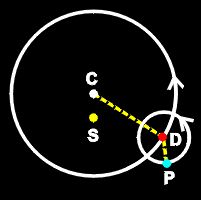
In his system for the motions of the heavenly bodies, Copernicus put the sun at the center of the universe and made the planets orbit around it. The earth turned on its axis one time every day which made it necessary to distinguish between apparent and real motions. Copernicus believed that the motions of the planets were circular and uniform about the center of a circle, so he had to include two of Ptolemy’s constructions to explain the variable movements of the planets. The two constructions were epicycles and eccentrics which made the Copernican system about as inaccurate as the Ptolemaic system. An example of the Copernican system is shown below. See Ptolemy’s constructions.
|
| Figure 1: An example of the copernican system. The center of the circle (C) is offset from the sun (S). The planet (P) moves around the center of its epicycle (D) which in turn revolves around the center of the large circle (C). |
Copernicus was never able prove his theory, but it did provide a foundation for Kepler’s work.
If you do not see frames, click here to go to the frames page.
If you do not want to use frames, click here to go to the non-frames home page
and sitemap.