Einstein
Albert Einstein (1879 - 1955) was born on March 14, 1879 in Ulm, Wurttemberg, Germany, to parents of German and Jewish descent. Like Newton, he did not show any genius qualities as a child. When he was five years old, his father gave him a compass. He was impressed that the needle would keep it’s orientation no matter which direction the compass was pointed. He later said that he thought that “something deeply hidden had to be behind things”. Later he went to public school in Munich and Aarau, but became uninterested in the methods of the German education and would miss lessons so that he could go off and satisfy his appetite for reading. He entered the Swiss Polytechnic Institute in Zurich at age 17 after intense study of mathematics, a subject he had somewhat neglected, where he studied mathematics and physics. He graduated in 1900 and got a job as a patent examiner at the Swiss Patent Office in Bern in 1902.
He spent his free time on scientific observations and became a Swiss citizen in 1905. That year, he also sent three papers to a German Scientific Periodical, the Annalen der Physik (Annals of Physics), each of which became the basis for a new branch of physics. In one paper, Einstein described how light could be thought of as a stream of tiny particles, which became an important part of the quantum theory. His paper also described the theoretical basis for an electric eye, a device which later made sound motion pictures, television, and other inventions possible. Einstein received the Nobel prize in physics for this paper in 1922. His second paper was entitled “The Electrodynamics of Moving Bodies” which introduced his Special Theory of Relativity. The third paper concerned Brownian Motion, the strange behavior of microscopic particles in a liquid or gas, which confirmed the atomic theory. That year, 1905, he received a doctorate in physics from the University of Zurich.
In 1909, Einstein became professor of theoretical physics at the University of Zurich. He became professor of the same subject at the University of Prague in 1911. He then had a similar job at the Federal Institute of Technology in Zurich in 1912. In 1913, Einstein was elected to the Prussian Academy of Sciences in Berlin and in 1914, he again became a German citizen when he accepted the position of Professor of Physics at the University of Berlin. Two years later, in 1916, he published his General Theory of Relativity which added gravity to the Special Theory. Einstein was never satisfied with his General Theory of Relativity because it did not include magnetism so he spent the last twenty five years of his life trying to combine magnetism and gravity into a single theory called the unified field theory but failed.
He visited England and the United States in 1933, and while he was away, the Nazi government took his positions, citizenship and properties away. He accepted a position as a staff member at the Institute for Advanced Study in Princeton N. J., where he stayed for the rest of his life. In 1940, Einstein became a United States citizen. He supported Zionism, the movement concerned with the development of Israel, and was offered the Presidency of Israel in 1952, but he declined the offer. Albert Einstein died on April 18, 1955. One of his favorite quotes was from a German proverb: “God is subtle, but he is not malicious.”
The Special Theory of Relativity
Since Newton published his laws of physics, until Einstein proposed his theories of Relativity, scientists thought that the speed of light was not a constant but varied with how fast an observer was moving. Time was thought of as absolute and separate from three dimensional space. Gravitation was thought of as an instantaneous force which had an infinite speed. They also thought that motion was relative, if it had to do with matter, but not if it had to do with electromagnetic waves.
For an example of Newtonian physics, which deals with matter, we can imagine a man with a ball inside a train, which is moving at a perfectly constant and very high speed along a perfectly straight and smooth track which is on a perfectly flat piece of ground in a world where air resistance does not exist. If that man drops the ball, he would see the ball fall straight down. If the man got out of the train and dropped the same ball, he would not be able to tell any difference in how it moved. A person outside the train would see the ball move in a curve when it is dropped. Newtonian laws agree with this because the ball and train are moving at the same speed and both are acted upon by the same forces. Both the train and the ball tend to move in a straight line until acted upon by gravity when the man drops the ball. It follows from this that the man outside the train would see the ball move faster than the man inside the train would since the man inside the train is already moving with the ball, thus its relative movement is slower. This illustrates the classical relativity principle: if two systems move uniformly relative to each other, then all of the laws of mechanics are the same in both systems.
The problems with the theories of physics at that time had to do with light. Newton believed that light was a stream of particles. Other scientists believed that light was a wave. These scientists thought that since waves need a medium to travel through, such as air for sound waves, then light must also need a substance to travel through. They named this substance “ether”. Ether was supposed to be a substance which filled all space, but did not interfere with the motion of matter and thus could not be seen, weighed, or felt. It was supposed to be present everywhere, including inside matter. Light was supposed to move at a constant speed in relation to this substance. These scientists also thought that the classical relativity principle held true only for classical mechanics and not for electromagnetic waves such as light. It is now known that light has a dual nature, acting both as a particle and a wave, but scientists then did not know this.
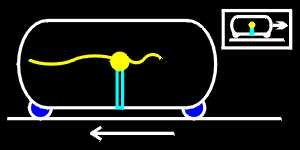
To see an example of the ether theory, we can imagine the above-mentioned train. We can also imagine that the person in the train has a device for measuring the speed of a beam of light coming into the front of the detector. He also has a light bulb attached to the front of his detector. According to the ether theory, if ether is stationary to the ground, then the person in the train would measure the speed of light coming from the light bulb as slightly slower or faster depending on which direction the indicator was facing. If the detector was facing toward the back of the train, the light coming into the device would be slightly slower than if the detector was facing forward. The light coming from the light bulb would move relative to the ground, thus, relative to the train, ether is like a kind of wind which slows light down in one direction, but speeds it up in the opposite direction. This is illustrated in the following image.
|
| Figure 1: The propogation of light according to the ether theory. Because ether is stationary to the ground, ether would tend to act as a type of wind pulling light toward the back of the train. |
If we assume that light is a stream of particles, as Newton did, then it does not need a substance such as ether to travel through. Again we will imagine the train, except this time the train is moving toward a light source and both people, the one in the train and the one on the ground, each have light speed indicator. Using Newtonian physics, we would assume that the speed of light coming from the light source for the man in the train would be slightly faster than for the man on the ground. Light would come from the light source at a constant speed but would not be received by every observer at the same speed. This is illustrated in the following example.
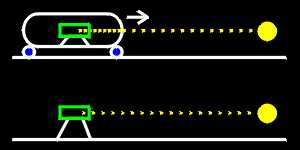 |
| Figure 2: The propogation of light if time is constant. The light from the light source moves away from the light source but is recieved by the train as faster than by the stationary detector. Note: The view of the inside of the train car is relative to the car. |
If we think of time as constant, then we would have to assume that one of these theories must be correct. Both are wrong. It was shown by experiments in Einstein’s day that the speed of light is constant, independent of the relative motion of the observer. This violates Newtonian physics and the ether theory.
Albert Einstein was dissatisfied with the current theories so he constructed his own. He realized that all motion and position is relative, that is, the description of movement or position is meaningless unless the reference body is defined. For instance, if I said that the ball in the train mentioned at the beginning was moving at 30 kilometers per hour, this statement would be meaningless unless I first told you which reference body I was using, the train or the ground. He also realized that the idea that two events happen at the same time is useless, since the only way we have of discovering this is to detect the light coming from the two events, and since light takes time to move, we can never be exactly sure that the two events took place at exactly the same time.
In creating his Special Theory of Relativity, he made it agree with two postulates (requirements given without proof). The first is that the laws of physics must be the same for a fixed observer as for an observer which is moving at a constant speed relative to the first observer. This concept was introduced by Henri Poincaré in 1904 who called it the principle of relativity. The second postulate Einstein used was that the speed of light in a vacuum must be exactly the same for every observer, independent of how fast or what direction they are moving.
These two requirements would at first seem to contradict each other. For an example of this, we can take the train and again move it toward a light source. Each person also would have a light detector pointed toward the light source. According to the Special Theory of Relativity, each person would detect light moving at exactly the same speed, even though the first person is in the train moving at a high speed toward the light and the other is standing still. An illustration of this follows.
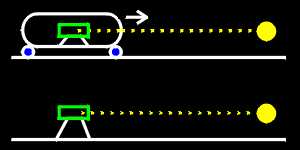 |
| Figure 3: The propogation of light according to the evidence. The speed of light for every observer is constant. Note: The view of the train car is relative to the car. Compare to figure 2. |
In his theory, Einstein treated time and space as a single four-dimensional space-time continuum. To account for the above problem, he used the Lorentz transformation. The Lorentz transformation is a set of mathematical formulas which satisfy the condition that the speed of light for two bodies of reference moving at a constant speed in a straight line relative to each other, is the same. In this case, the two reference bodies are the train and the ground. He found that time slows down for a reference body the faster it goes in relation to other reference bodies. He also found that, according to an observer on the ground, the train would be slightly shortened in the direction of its movement.
A consequence of Einstein’s theory is that no object can move faster than the speed of light. He corrected Newton’s second law of motion F = ma (force = mass X acceleration). Since it was already known that according to the theory nothing can travel faster than light, then increasing force applied to an object can not accelerate it beyond the speed of light. To prevent something from accelerating beyond this speed, an object’s mass must increase as velocity increases. If this is true, then it follows that energy and matter are interchangeable. The equation that expresses the relationship between matter and energy is expressed in Einstein’s famous equation:
e is energy
m is mass
c is the speed of light

This equation accurately describes the release of energy in a nuclear reaction. The Special Theory of Relativity was published in 1905.
In 1926, Albert Abraham Michelson designed an experiment to measure the speed of the earth through ether. He built a device which compared the speeds of two perpendicular light beams. By measuring the interference pattern of the two light beams, he thought he could measure the speed of the detector through ether. He found that the speed of the earth compared to ether was zero. American chemist and physicist Edward Morley helped him refine his experiment with the same result. His experiments helped destroy the ether theory.
The General Theory of Relativity
The Special Theory of Relativity describes the events which take place in a universe with no gravity. In 1916, Einstein published his General Theory of Relativity with the help of his friend and mathematician Marcel Grossman.
Before this theory, each object was thought to have gravitational and inertial mass. Gravitational mass was the weight, or effect of gravity on the object. Inertial mass was the measure of how much force had to be applied to the object to accelerate it a certain amount. Einstein realized that these two masses were equal, thus each object had only one value for its mass.
Einstein also saw no difference between how a gravitational field affected an object and how a moving frame of reference affected an object. For instance, if a man was in a closed box that was accelerated at a uniform rate, he could drop a ball and see it fall to the floor. His body would also be pulled toward the bottom of the box and he would assume that a gravitational field was pulling both him and the ball toward the side of the box he called the floor. In a few minutes, the box would attain an incredible speed but the man in the box would not know it. This box is illustrated in the following example.
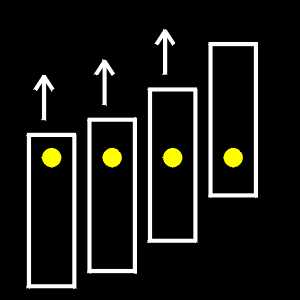 |
| Figure 4: The effect of a moving frame of reference on an object. To an observer outside of the box, the yellow ball looks as if it stays in the same place but the box moves. To an observer inside the box, the ball would look as it is falling, or being acted on by a gravitational field. |
Einstein realized that the man would not be able to tell the difference between this and being in the same box sitting on earth in a real gravitational field because the objects in the box would be acted on in the same way. Thus gravitational and inertial mass must be equal. Also, space around objects must be curved in such a way that a real gravitational field around an object would influence the objects around it in the same way the accelerating box did. Thus, matter tells space how to curve, and space tells matter how to move.
Einstein also realized that relative to this box, light would not follow a completely straight path, rather it would be curved toward the bottom of the box because of the continuing acceleration of the box. Einstein applied this curvature of light to real gravitational fields. This theory was verified when scientists observed that the stars around the sun in a total solar eclipse appeared to be shifted outward from the sun slightly. This is illustrated in the following image.
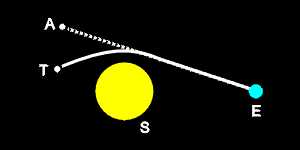 |
| Figure 5: The effect of the gravitational field of the sun on the apparent position of the stars. Because of the curvature of light around the sun (S), the star, as seen from earth (E) looks like it is at position A even though the star is really at position T. |
Einstein also believed that a gravitational field affected time, which was later verified with atomic clocks. To come to this conclusion, he decided to put the imaginary man into a huge rotating disk. The disk, because it is rotating, experiences centrifugal force which the man interprets as another gravitational field. To him, light curves in the same way as it did in the box and objects are acted on in the same way. This time, however, he has two very precise clocks which are perfectly synchronized. One of these clocks he puts at the center of the disk, so that it is not moving. The other, he puts at the edge of the disk. Because of the laws of the Special Theory of Relativity, the clock at the edge, since it is moving faster than the clock in the center of the disk, looses time. Thus, he applied this to real gravitational fields and came to the conclusion that a gravitational field slows time.
Einstein’s theories revolutionized physics and helped start the atomic age. For more information, read Einstein’s book Relativity.
For more information, go to:
If you do not see frames, click here to go to the frames page.
If you do not want to use frames, click here to go to the non-frames home page
and sitemap.