Galileo
Galileo Galilei (1564-1642) was born in Pisa, Italy on February 15, 1564 and is considered by some to be the founder of modern experimental science. Around 1570, the Galilei family moved to Florence where Galileo got his education from a nearby monastery. In 1581, Galileo was sent to The University of Pisa by his father, Vincenzio Galilei, to become a doctor. He studied medicine and the philosophy of Aristotle for the next four years but he was never really interested in medicine. He discovered a talent for mathematics and in 1585 persuaded his father to let him leave the university. He moved back to Florence and became a tutor in mathematics. During this time, he started to question Aristotelian philosophy and the scientific thought of that time. He also invented the hydrostatic balance, a device which measured the specific gravity of an object by weighing it in water.
In 1589, Galileo was appointed to professor of mathematics at the University of Pisa, a position which required him to teach Ptolemaic astronomy. In preparing for these courses, he gained an understanding of astronomical theory. Next, he became a professor of mathematics at the University of Padua in 1592, where he remained for the next 18 years. During this time, he became convinced of the Copernican theory. In 1609 he built his own telescope based on a device he had heard about which used lenses to magnify distant objects. Using his telescope, he found evidence which disproved Ptolemy and Aristotle. He found that the moon, which Aristotle and Ptolemy had thought was smooth, had craters and mountains. He also found four of Jupiter’s moons, bodies which were obviously not orbiting the earth. He named these satellites the “Medicean Planets” to try to gain the favor of the Medicis, the family which ruled Florence in Galileo’s time.
In 1610, the Grand Duke of Tuscany, Cosimo de Medici, appointed Galileo his personal mathematician, a job which required him to move back to Florence. There he made more discoveries such as sun spots and the phases of Venus, which confirmed his belief in the Copernican theory. Galileo was not the first person to study sun spots, the Chinese had known about them since about 90 B.C., but it helped the Copernican case since Aristotle and Ptolemy thought that the heavenly bodies were smooth. He started publishing his findings in 1610 which brought him wide renown. Galileo also discovered that the Milky Way was made up of many individual stars.
Galileo studied motion, especially that of freely falling bodies. He saw a problem with the Aristotlelian theory of motion because it required a stationary earth so he developed his own theory of motion. He is probably best known for a story in which he dropped two different size balls from the Leaning Tower of Pisa at the same time. The two balls hit the ground at almost the same time which led him to formulate the law of freely falling bodies. There is no evidence that he actually conducted this experiment, but he was the first scientist to use the results from experiments for evidence for a scientific theory. He also experimented with pendulums and formulated the law of the pendulum.
Galileo had sent a letter to Kepler stating that he believed in the Copernican theory but in 1613 in a book about sunspots he stated his belief publicly. In 1616, he was summoned to Rome and ordered not to hold or defend the Copernican theory. In 1632, he published his Dialogue concerning the two Chief World Systems in which he presented arguments for and against the earth-centered and sun-centered planetary systems. He was summoned before the Inquisition and he was sentenced to life imprisonment for his views. Because of his ill health and his age, however, he was allowed to serve out his sentence under house arrest in a villa near Florence. Galileo, despite his ill health, managed to finish his Discourse on Two New Sciences which was published in 1638. In his new book, he provided a mathematical proof of his theory of motion and a study of the tensile strength of materials. By this time, Galileo was completely blind. He died four years later in 1642.
In 1979, Pope John Paul II declared that the Roman Catholic Church may have been mistaken in condemning Galileo. He established a commission to study the case.
Galileo’s work, and the common sense way he approached problems, opened the way for more research with physics which eventually led to modern mathematical physics.
Aristotle believed that if two objects of different mass were dropped at the same time, the heavier one would hit the ground first. Galileo did not believe this. He reasoned that if two bricks of the same size and mass were dropped at the same time, they would hit the ground at the same time. He also reasoned that it would not make any difference in the speed the bricks fell if the two bricks were glued together. Thus, the two glued bricks would fall at the same rate as a third brick which had the same size and mass as the first two. If this were true, then it did not make any difference how heavy two objects were, they would both fall at the same rate if they were not acted upon by air resistance. Some scientists disagreed until Galileo’s theory was proven when the air pump was invented in 1650. A coin and a feather were both dropped at the same time in an evacuated tube and they hit the other end at the same time.
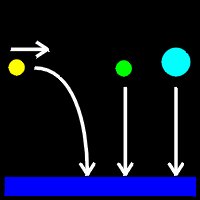
The law of falling bodies assumes that no air is present to act on the objects being dropped. It says that, under the influence of gravity alone, all bodies fall with equal acceleration, regardless of size, mass, density, or horizontal velocity. This is illustrated in the image below.
|
| Figure 1: Three balls falling to the ground at the same time even though the one on the left has horizontal motion and the one on the right has more mass. |
If you do not see frames, click here to go to the frames page.
If you do not want to use frames, click here to go to the non-frames home page
and sitemap.