
The Pythagorean Theorem and Distance Formula
The Pythagorean Theorem:
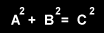
The Pythagorean theorem is a theorem which says that for every right triangle, the square of the hypotenuse equals the sum of the squares of the two other sides. This is illustrated in the following image.
|
| Figure 1: The Pythagorean Theorem. The blue side is the hypotenuse. |
The mathematical form of the Pythagorean theorem follows:
The Distance Formula:
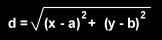
The distance formula is a method of determining the distance of a line segment between two points. It can be derived using the Pythagorean theorem.
The distance formula follows:
x and y are the x,y coordinates for the first point
a and b are the x,y coordinates for the second point
d is the distance between the two points
If you do not see frames, click here to go to the frames page.
If you do not want to use frames, click here to go to the non-frames home page
and sitemap.