 |
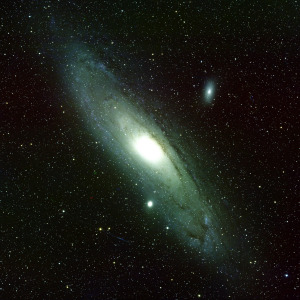
| The Andromeda Galaxy (M 31). Copyright Association of Universities for Research in Astronomy Inc. (AURA), all rights reserved. |
Galaxies
|
| The Andromeda Galaxy (M 31). Copyright Association of Universities for Research in Astronomy Inc. (AURA), all rights reserved. |
Galaxies are groups of stars, gas, and dust. These groups contain most of the observable matter in the universe. Most galaxies can be divided into three groups: elliptical, spiral, and irregular. There is also a class of galaxies called S0 galaxies. Few galaxies exist alone and multiple systems are common.
 |
| An Elliptical Galaxy (M 32). Copyright Association of Universities for Research in Astronomy Inc. (AURA), all rights reserved. |
Elliptical galaxies are galaxies which do not contain much interstellar matter and do not have any clearly defined internal structures. The true shape of these galaxies are not known because the inclination of the galaxy in relation to the line of sight is not known.
 |
| A Spiral Galaxy (M 83). Copyright Association of Universities for Research in Astronomy Inc. (AURA), all rights reserved. |
Spiral galaxies are flattened and have spiral arms containing stars and interstellar matter. They also have a dense central nucleus. Most spiral galaxies have two arms. The Milky Way galaxy is a spiral galaxy.
Irregular galaxies contain large amounts of interstellar matter and have no observable symmetry. These galaxies are usually below average in size.
S0 galaxies are galaxies which have a central nucleus and a small disk, but show little or no evidence of a spiral structure.
If you do not see frames, click here to go to the frames page.
If you do not want to use frames, click here to go to the non-frames home page
and sitemap.