 |
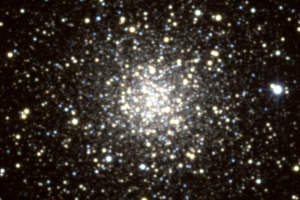
| A Globular Cluster (M 56) Copyright Association of Universities for Research in Astronomy Inc. (AURA), all rights reserved. |
Stars
|
| A Globular Cluster (M 56) Copyright Association of Universities for Research in Astronomy Inc. (AURA), all rights reserved. |
Stars come in many different forms and are objects which generate energy with nuclear reactions in their cores. The sun is our closest star and gives light to the solar system. The sun also gives off solar wind, a flow of charged particles, mainly protons and electrons, which moves through the entire solar system. The expansion of this solar wind is controlled by the sun’s magnetic field. The stars at the center of our galaxy also give off a wind which is called the interstellar wind.
Categories
There are many different kinds of stars. In addition to normal stars, there are also many different types such as pulsars, quasars variable, and multiple stars. These stars are classified in many different categories which are listed below.
Variable stars are stars whose brightness varies over time. This change can be regular, irregular, or in between. Variables can be extrinsic or intrinsic. Extrinsic variables vary their brightness because of an outside influence such as an orbiting star. Intrinsic variables vary their brightness because of an inside influence such as expanding or contracting outer layers.
Binary stars are pairs of stars which are orbiting a common center of mass. Multiple stars are a group of three or more stars which are orbiting around their center of mass. Binary stars are sometimes considered multiple stars. Multiple and binary stars are very common and the orbits of the stars involved can be very complicated.
A red giant is a star which has a diameter 10 - 100 times greater than that of the sun. These have surface temperatures between 2000 and 3000 degrees Kelvin. Red giants are often variable stars because their surface layers expand and contract.
When a star blows off its outer layers, a nova occurs. When this happens, there is a sudden increase in brightness for days and sometimes weeks. The period of time when the star decreases in brightness can range from months to years. When a star blows off all or most of its material, a supernova occurs. A supernova is much brighter than a regular nova and can be brighter than magnitude -15.
A pulsar is a pulsating source of radiation thought to come from a rotating neutron star. A neutron star is a star which is compressed by its own gravity to such a degree that its material is compressed into neutrons, one of the subatomic particles. Pulsars have very regular periods and emit radiation at optical, radio, x-ray and gamma-ray wavelengths.
Quasars are objects which are outside our galaxy and look like a point of light, but emit more energy than a hundred supergiant galaxies. There is evidence which indicates that the light-producing portions of quasars can not be more than one light year across. The only process known to be efficient enough for this is a supermassive black hole in the center of the quasar. Some quasars have a fuzz surrounding them which is believed to be surrounding galaxies.
Black holes are stars which are so collapsed under their own gravity that their escape velocity exceeds the velocity of light. A black hole has not been unambiguously detected but there is strong evidence to support their existence. If a collapsing object shrinks beyond a certain radius, it becomes a black hole. Calculations show that the ultimate fate of the object is to become infinitely compressed.
A white dwarf is a star which has undergone a gravitational collapse following the exhaustion of nuclear fuel. The light from a white dwarf star is caused by a thin gaseous atmosphere that slowly leaks into space. These objects are very faint and are not always white, going through white, yellow, and red as they cool down until they reach their final state when they are called black dwarfs. Sometimes white dwarfs collapse further to become neutron stars or black holes.
Many stars are organized into clusters, large numbers of stars which are roughly the same distance from earth. There are two types of clusters, globular clusters and open clusters. Globular clusters are groups of stars which are organized into a spherical shape. The concentration of stars in a globular cluster greatly increases towards the center of the cluster. Most globular clusters appear to have highly eccentric elliptical orbits around the galactic center. Open clusters are smaller and more loosely bound than globular clusters. They contain at most a few hundred stars and sometimes less than twenty.
If you do not see frames, click here to go to the frames page.
If you do not want to use frames, click here to go to the non-frames home page
and sitemap.