 |
| The Earth. Taken by Galileo. Courtesy: NASA/JPL/Caltech. |
Earth
|
| The Earth. Taken by Galileo. Courtesy: NASA/JPL/Caltech. |
Earth, our home world, is the base from which we study the stars. It is the third planet from the sun and the only one in the universe currently known to contain life. The earth orbits the sun in an elliptical orbit. The average distance from the earth to the sun is called an astronomical unit (AU) and is used to measure the relative distances of other planets to the sun. The earth also rotates once every day. The center of this spin is an imaginary line called the earth’s axis of rotation. One end of this axis is called the north pole, the other end is called the south pole. Perpendicular to this axis is the equator. The equator is a large circle which goes around the earth. The earth is not quite a perfect sphere. Because of the rotation of the earth, centrifugal force pulls the earth’s mass toward the equator to deform the earth into a form known as a geoid. The equator divides the earth into two halves, the northern and southern hemispheres. A line called the prime meridian divides the earth into eastern and western hemispheres. See Coordinate Systems.
The Composition of Earth
The earth’s atmosphere is composed of nitrogen and oxygen in the ratio of 78 to 21 respectively. It extends about 1600 km (1000 miles) above the surface. The oxygen in the upper atmosphere is converted to ozone by radiation from the sun and shields us from the sun’s harmful ultraviolet rays.
From studying seismic activity, scientists have come to the conclusion that the earth is divided into four layers. These layers are the crust, the mantle, the outer core, and the inner core.
The crust is on the outside of the earth and contains all of the land and oceans. The thickness of the crust varies from about 5 miles under the oceans to about 25 miles under the continents. The temperature in the deepest parts of the crust may reach 1600 degrees Fahrenheit (870 degrees Celsius), hot enough to melt rocks. The crust is made up of mostly of silicon and magnesium. About 70% of the earth is covered by water.
The mantle is directly below the crust and is a thick layer of solid rock extending toward the center of the earth about 2,900 km (1800 miles). The mantle ranges in temperature from about 1600 deg. F (870 deg. C), where it meets the crust, to about 4000 deg. F (2200 deg. C).
The outer core is the next layer below the mantle and scientists believe that it is 2,250 km (1,400 miles) thick. It is made up of molten iron and nickel. Its temperature ranges from about 4000 deg. F (2200 deg. C) to about 9000 deg. F (5000 deg. C).
The inner core is the center of the earth. It begins about 5,150 km (3,200 miles) below the earth’s surface. It is about 1,300 km (800 miles) in radius. Scientists believe that it may be made up of solid iron and nickel.
An illustration of the earth is shown below.
 |
| Figure 1: A cutaway of the earth. |
Earth's Magnetic Field
In addition to geographic north and south poles, the earth also has magnetic poles. The earth’s magnetic field can be compared to the field of a huge bar magnet inside of the earth. All magnets on the earth’s surface that are allowed to move will align themselves with this field, which is how a compass works. The north magnetic pole is currently near Barhurst Island in northern Canada, about 1600 km from the geographic north pole. The south magnetic pole is off the coast of Wilkes Land, part of Antarctica, about 2750 km from the geographic south pole. There is evidence that these poles may have reversed sometime in history, but scientists do not yet understand why. Scientists believe that the magnetic field may come from the movement of molten rock in the earth’s core. This magnetic field is called the magnetosphere and it interacts with the solar wind to guide the wind away from the planet. The solar wind is a flow of charged particles guided away from the sun by the sun’s magnetic field. As the solar wind hits the magnetosphere, it creates a layer of turbulent magnetic field where the solar wind is deflected away from earth. The solar wind deforms the magnetosphere and sweeps it out behind the earth. The magnetosphere extends toward the sun about 60,000 km but is swept out many times that distance on the other side. The magnetosphere usually deflects most of the particles away from the earth, but sometimes the sun throws out unusually large amounts of particles. These particles interact with earth’s atmosphere near the poles and cause a many-colored glow called the aurorae. The southern aurora is called the aurora australis; the northern aurora is called the aurora borealis. Some particles become trapped in the magnetosphere and form the Van Allen radiation belts. The magnetosphere and the Van Allen belts are illustrated in the following image.
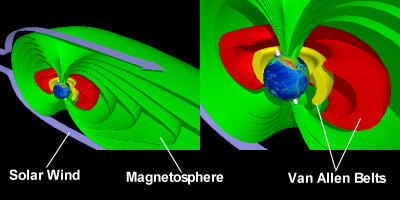 |
| Figure 2: The earth's magnetosphere, the solar wind, and the Van Allen belts. |
Fact Sheet |
||
| Planet Name | Earth | |
| Latin Name/Greek Name | Terra/Gaea | |
| Symbol |  |
|
| Year Discovered/Discoverer | N/A | |
| Mass | 5.9742 x 1027 g | |
| Volume | 1.083 x 10¹² km3 | |
| Density | 5.515 gm/cm3 | |
| Surface Gravity | 980 cm/s2 | |
| Escape Velocity at Equator | 11.18 km/s | |
| Mean Equatorial Radius | 6,378.14 km | |
| Albedo (Percentage of light reflected) | .37 | |
| Mean Temperature at Solid Surface | 288 - 293 K | |
| Motion | ||
| Sidereal Rotation Period (Earth Days) | 0.99726968 | |
| Rotation Direction | Direct | |
| Length of Solar Day | 24 hours | |
| Orbit | ||
| Sidereal Orbit Period (Earth Years) | 0.99997862 | |
| Mean Orbit Velocity | 29.7859 km/s | |
| Orbit Eccentricity | 0.01671022 | |
| Mean Distance (Semimajor Axis) from Sun | 149,597,890 km | |
| Inclination of Orbit to Ecliptic | 0.00005 degree | |
| Inclination of Equator to Orbit | 23.45 degrees | |
| Natural Satellites | Moon | |
If you do not see frames, click here to go to the frames page.
If you do not want to use frames, click here to go to the non-frames home page
and sitemap.