 |
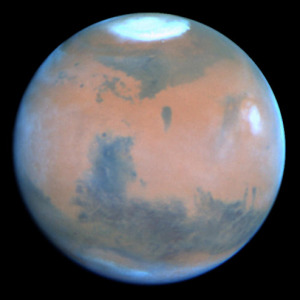
| Mars. Taken by the Hubble Space Telescope. Credit: Philip James (University of Toledo), Steven Lee (University of Colorado), NASA |
Mars
|
| Mars. Taken by the Hubble Space Telescope. Credit: Philip James (University of Toledo), Steven Lee (University of Colorado), NASA |
Mars, known as the "Red Planet," is named after the Roman god of war. It is the fourth planet from the sun. It is the only planet whose surface can be seen in detail from the earth. And when looking at it through a telescope, the surface of Mars has three outstanding features- bright areas, dark areas, and polar caps.
The bright areas of Mars are reddish rust-brown in color and cover about two-thirds of the planet's surface. They are dry, desertlike regions that are covered by dust, sand, and rocks.
The dark areas of Mars cover about one-third of the planet's surface. They form irregular patterns, and generally appear greenish-gray or bluish-gray. These dark regions have historically been called maria (seas), even though the areas don't contain any measurable amounts of water. The color, shape, and size of these areas vary from season to season.
The polar caps of Mars are small areas located at the planet's north and south poles. The polar caps appear white from earth, and are thought to contain large amounts of frozen water. Like the maria, each polar cap grows and shrinks with the changing seasons. They appear to evaporate and shrink during the time when they are pointed towards the sun, then freeze and grow larger again while turned away from the sun.
Mars has an off-center orbit. At one extreme of its orbit Mars loops 42.4 million km farther from the Sun than at the other. Its average distance from the sun is about 141,700,000 miles. At its closest approach to earth, Mars is 48,700,000 miles away. The rotation of Mars is very similar to that of Earth. And like Earth, Mars' tipped axis causes seasons.
Because Mars moves faster when close to the sun, and slower when farther away, its seasons differ in length. Northern spring lasts 52 Martian days more than fall. Mars rotates once every 24 hours and 37 minutes. One year on Mars takes about 687 earth days. The surface conditions on Mars are more like the Earth's than those of any other planet. The temperature on Mars ranges from -191F to -24F.
The mass of Mars is slightly more than that of Mercury. (It is
the third smallest.) Its mass is 0.11 (Earth being 1).
Mars has two moons, Deimos and Phobos. Deimos, which hovers 20,123km
above Mars, orbits every 30 hours. Phobos, which hovers at only 5,973km,
orbits in less than 8 hours. Phobos rises and sets twice every
day.
Fact Sheet |
||
| Planet Name | Mars | |
| Latin Name/Greek Name | Mars/Ares | |
| Symbol |  |
|
| Year Discovered/Discoverer | N/A | |
| Mass | 0.64191 x 1027 kg | |
| Volume (Earth = 1) | 0.149 | |
| Density | 3.94 gm/cm3 | |
| Surface Gravity | 371 cm/s2 | |
| Escape Velocity at Equator | 5.02 km/s | |
| Mean Equatorial Radius | 3,397 km | |
| Albedo (Percentage of light reflected) | .15 | |
| Mean Temperature at Solid Surface | 186 - 268 K | |
| Motion | ||
| Sidereal Rotation Period (Earth Days) | 1.02595675 | |
| Rotation Direction | Direct | |
| Orbit | ||
| Sidereal Orbit Period (Earth Years) | 1.88071105 | |
| Mean Orbit Velocity | 24.1309 km/s | |
| Orbit Eccentricity | 0.09341233 | |
| Mean Distance (Semimajor Axis) from Sun | 227,936,640 km | |
| Inclination of Orbit to Ecliptic | 1.85061 degrees | |
| Inclination of Equator to Orbit | 25.19 degrees | |
| Natural Satellites | Phobos Deimos |
|
If you do not see frames, click here to go to the frames page.
If you do not want to use frames, click here to go to the non-frames home page
and sitemap.