 |
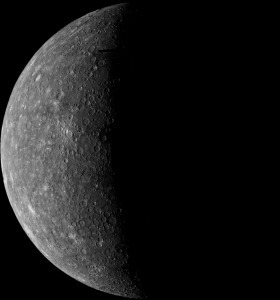
| Mercury. Taken by Mariner 10. Courtesy: NASA/JPL/Caltech |
Mercury
|
| Mercury. Taken by Mariner 10. Courtesy: NASA/JPL/Caltech |
Mercury. Until March 29, 1974 this planet was partly shrouded in mystery and myth. Named after the messenger of the Roman gods, this planet has been in myth and lore for thousands of years. On March 29, 1974 the Mariner X flew within 460 miles of this planet. It was the first to take pictures and data from this planet.
When looking from the Earth Mercury looks like just a little dot against the sun. In fact, since this planet is so small and only 36 million miles from the sun, a telescope is needed to see it.
Mercury only rotates once every 59 earth days. And its year is equivalent to only 88 earth days.
The temperature just before sunrise on Mercury is -183 degrees Celsius. That temperature rises to 27C by mid morning, and 407C by noon. By the time early afternoon comes around the temperature on Mercury has risen to 427C.
Mercury's diameter is 3,031 miles (4,878 kilometers). The only planet smaller than Mercury is Pluto. Mercury has no satellites or moons.
Mercury's surface looks a lot like our moon's. It doesn't have enough of an atmosphere to slow down any meteors that come its way. In fact, it is almost airless. The greatest possible atmospheric pressure would be about 0.00000000003 pounds per square inch. Earth's atmospheric pressure is 14.7 pounds per square inch. It is impossible that this planet would be able to sustain life. If the heat didn't get you, the airless environment would.
If we could stand on Mercury and look towards the sun we would see the sun climb for about a month of earth time and then seem to "loop"- slow down, stop, back up, stop again, and then resume its westward movement until it set a month and a half later. If we stood in another place and looked again at the sun we would be able to witness two sunrises and two sunsets each day. The reason behind these strange events is that Mercury has a highly elliptical orbit and because at perihelion its spin speed is slower than its orbital speed.
We may not look at Mercury as somewhere that we may live, but this planet is an interesting planet because of its closeness to the sun. By sending instruments there, we would be able to measure changes in the sun's gravitation and in the solar wind.
Fact Sheet |
||
| Planet Name | Mercury | |
| Latin Name/Greek Name | Mercurius/Hermes | |
| Symbol |  |
|
| Year Discovered/Discoverer | N/A | |
| Mass | 0.3302 x 1027 | |
| Volume (Earth = 1) | 0.54 | |
| Density | 5.43 gm/cm3 | |
| Surface Gravity | 370 cm/s2 | |
| Escape Velocity at Equator | 4.25 km/s | |
| Mean Equatorial Radius | 2,439.7 km | |
| Albedo (Percentage of light reflected) | .11 | |
| Mean Temperature at Solid Surface | 440 K | |
| Motion | ||
| Sidereal Rotation Period (Earth Days) | 58.646225 | |
| Rotation Direction | Direct | |
| Orbit | ||
| Sidereal Orbit Period (Earth Years) | 0.24084445 | |
| Mean Orbital Velocity | 47.8725 km/s | |
| Orbit Eccentricity | 0.20563069 | |
| Mean Distance (Semimajor Axis) from Sun | 57,909.175 km | |
| Inclination of Orbit to Ecliptic | 7.00487 degrees | |
| Inclination of Equator to Orbit | 0.0 degrees | |
| Natural Satellites | None | |
If you do not see frames, click here to go to the frames page.
If you do not want to use frames, click here to go to the non-frames home page
and sitemap.