 |
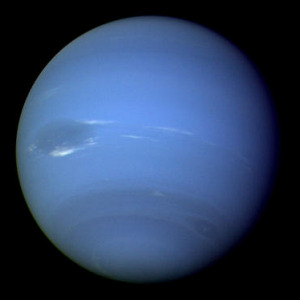
| Neptune. Taken by Voyager 2. Courtesy: NASA/JPL/Caltech |
Neptune
|
| Neptune. Taken by Voyager 2. Courtesy: NASA/JPL/Caltech |
As the smallest and last of the great gas giants, Neptune glows a pale blue against the forever black darkness of space. Perhaps this is the reason it was named after the Roman god of the sea.
Out at the far fringes of our solar system Neptune is sometimes the second to the last planet. Its average distance from the sun is 2,788,000,000 miles (4,486,100,000 kilometers). That's more than 30 times Earth's distance from the sun. Neptune can't be seen without a telescope.
As Neptune and Pluto go around the sun they switch places. Every 248 years Pluto moves inside Neptune's orbit for about 20 years. During this 20 year period Neptune becomes the last planet from the sun. Pluto entered Neptune's orbit on January 23, 1979 and remained there until March 15, 1999.
Until 1846 the existence of Neptune was unknown to the world. Astronomers noticed that Uranus was moving along its orbit faster than expected, but later they noticed that it had slowed down. Apparently there was a mystery planet tugging at Uranus. In 1843 John C. Adams, a young English astronomer and mathematician, began working to find the location of this unknown planet. Adams predicted that this planet would be about 1 billion miles (1.6 billion kilometers) farther from the sun than Uranus. He sent his work to Sir George B. Airy, but Airy didn't look for the planet. Meanwhile Urbain J.J. Leverrier, a French mathematician, had come up with very similar predictions. He sent them to Urania Observatory in Berlin, Germany. On Sept. 23, 1846, Johann G. Galle, the director of the observatory, and his assistant, Heinrich L. d' Arrest, found Neptune near the position predicted by Leverrier. Both Adams and Leverrier are credited for the discovery.
Neptune's diameter is about 30,200 miles (48,600 kilometers). That's about four times the diameter of Earth. Neptune is about 17 times as heavy as the earth, but it isn't as dense.
Neptune goes around the sun every 165 earth-years. It will be 2011 before it returns to the place it was when it was discovered in 1846.
Neptune has two satellites, Triton and Nereid. Triton is about 3,000 miles (4,800 kilometers) in diameter and about 200,000 miles (320,000 kilometers) from Neptune. Triton is the only large satellite in our solar system that travels from east to west. It has a circular orbit, and completes one orbit around Neptune every six days.
Nereid is only about 150 miles (241 kilometers) in diameter. It is about three and a half million miles (5.6 million kilometers) from the planet, and it travels in an orbit that is extremely elliptical. It completes one trip around Neptune every 360 earth-days.
Astronomers don't know much about Neptune's surface because it is so far away, but they believe that the blue part visible from Earth is the top of a thick layer of clouds. These clouds may consist of frozen ammonia, or combinations of crystals of ice, frozen methane, and frozen ammonia. The thickness of these clouds is believed to be about 2,000 miles (3,200 kilometers).
Fact Sheet |
||
| Planet Name | Neptune | |
| Latin Name/Greek Name | Neptunus/Poseidon | |
| Symbol |  |
|
| Year Discovered/Discoverer | 1846/John Couch Adams | |
| Mass | 102.44 x 1027 g | |
| Volume (Earth = 1) | 44 | |
| Density | 1.76 gm/cm3 | |
| Surface Gravity | 1100 cm/s2 | |
| Escape Velocity at Equator | 23.71 km/s | |
| Mean Equatorial Radius | 24,764 km | |
| Albedo (Percentage of light reflected) | .41 | |
| Motion | ||
| Sidereal Rotation Period (Earth Days) | 0.67125 | |
| Rotation Direction | Direct | |
| Orbit | ||
| Sidereal Orbit Period (Earth Years) | 163.7232045 | |
| Mean Orbit Velocity | 5.4778 km/s | |
| Orbit Eccentricity | 0.00858587 | |
| Mean Distance (Semimajor Axis) from Sun | 4,498,252,900 km | |
| Inclination of Orbit to Ecliptic | 1.76917 degrees | |
| Inclination of Equator to Orbit | 29.58 degrees | |
| Natural Satellites | Naiad Thalassa Despina Galatea Larissa Proteus Triton Nereid |
|
If you do not see frames, click here to go to the frames page.
If you do not want to use frames, click here to go to the non-frames home page
and sitemap.