 |
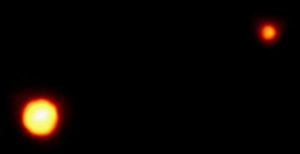
| Pluto and Charon. Taken by the Hubble Space Telescope. Credit: Dr. R. Albrecht, ESA/ESO Space Telescope European Coordinating Facility; NASA |
Pluto
|
| Pluto and Charon. Taken by the Hubble Space Telescope. Credit: Dr. R. Albrecht, ESA/ESO Space Telescope European Coordinating Facility; NASA |
At the outer reaches of our solar system a tiny ball of frozen material orbits in the night sky. This little ball has a gravity that is maybe 4 percent of Earth's. Its density is less than that of ice. And its mass is about one-sixth of our moon. This little ball is Pluto, and because it was so small, some astronomers weren't sure whether or not to label it as a planet, but it has been decided that Pluto should keep its planet status. Pluto was named after the Greek god of wealth, who also ruled the mythical underworld of Greek lore.
Pluto is the only planet which has been discovered by an American. Its discovery has been credited to Percival Lowell who founded the Lowell Observatory in Flagstaff, Arizona. Lowell made numerous unsuccessful calculations to find a planet called "Planet X". It didn't look very promising until Dr. Vesto Slipher, the observatory director, hired Clyde Tombaugh to help with the search. Clyde took several pictures one or two weeks apart and found the planet Pluto. It was later concluded that this wasn't the mysterious "Planet X" Lowell had hoped to find, but was a serendipitous discovery.
Pluto's surface consists of 98 percent nitrogen (N2), methane (CH4) and traces of carbon monoxide (CO). The presence of solid methane indicates that Pluto is colder than 70 degrees Kelvin.
Temperatures on Pluto are estimated to be around -342 to -369 degrees F. (-208 to -223 degrees C.). That is very near the point of absolute zero, where there is absolutely no heat and molecules cease to move.
Pluto has one moon, Charon. Charon orbits Pluto at a distance of about 12,200 miles (19,640 kilometers). It is common for a satellite for travel in a synchronous orbit with its planet, but in the case of Pluto things are just a little bit different. Instead of Charon being the one to travel synchronously with Pluto, Pluto rotates synchronously with Charon. This unusual occurrence causes Pluto and Charon to be locked facing each other as they orbit the Sun.
Charon was discovered by James W. Christy, a U. S. Naval Observatory scientist in 1978. It was named after the ferryman who rowed souls across the River Styx to the underworld of Greek and Roman mythology. Charon seems to be covered with water-ice rather than nitrogen-ice. Charon is bluer than Pluto. This indicates that Pluto and Charon have different surface composition and structure.
The passing of one year on Pluto takes 248 earth-years to be completed, and it takes six earth-days for one day to go by on Pluto. Pluto and Charon both share the same rotation period of 6.387 days.
Pluto has a very thin atmosphere which can freeze and fall to the surface as the planet moves away from the sun. NASA is planning to send a spacecraft to Pluto in 2001 to learn more about the atmosphere and to gather data about the atmosphere before it falls.
Pluto's average density is between 1.8 and 2.1 grams per cubic centimeter. It has been estimated that Pluto is 50 to 75 percent rock mixed with ices.
Fact Sheet |
||
| Planet Name | Pluto | |
| Latin Name/Greek Name | Pluto/Pluton | |
| Symbol |  |
|
| Year Discovered/Discoverer | 1930/Clyde Tombaugh | |
| Mass | 0.013 x 1027 g | |
| Volume | 0.005 | |
| Density | 1.1 gm/cm3 | |
| Surface Gravity | 81 cm/s2 | |
| Escape Velocity at Equator | 1.27 km/s | |
| Mean Equatorial Radius | 1,195 km | |
| Albedo (Percentage of light reflected) | .55 | |
| Mean Temperature at Solid Surface | 57.8 K | |
| Motion | ||
| Sidereal Rotation Period (Earth Days) | 6.38718 | |
| Rotation Direction | Retrograde | |
| Orbit | ||
| Sidereal Orbit Period (Earth Years) | 248.0208 | |
| Mean Orbit Velocity | 4.7490 km/s | |
| Orbit Eccentricity | 0.24880766 | |
| Mean Distance (Semimajor Axis) from Sun | 5,906,376,200 km | |
| Inclination of Orbit to Ecliptic | 17.14175 degrees | |
| Inclination of Equator to Orbit | 119.61 degrees | |
| Natural Satellites | Charon | |
If you do not see frames, click here to go to the frames page.
If you do not want to use frames, click here to go to the non-frames home page
and sitemap.