 |
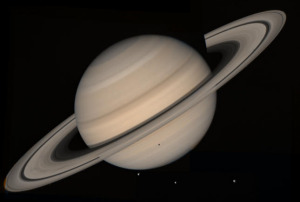
| Saturn. Taken by Voyager 2. Courtesy: NASA/JPL/Caltech |
Saturn
|
| Saturn. Taken by Voyager 2. Courtesy: NASA/JPL/Caltech |
Saturn. In 1610 when Galileo studied it with a telescope, he said he saw what he thought were ears. Now, with our high powered telescopes and space probes, we know that what Galileo thought were ears were actually a lot of thin, flat rings made up of ice particles that travel around the planet. The planet itself can be seen from Earth without the aid of a telescope, but its rings cannot.
Saturn is the second largest planet in our solar system. Its diameter at the equator is about 74,600 miles (120,000 kilometers), which is almost 10 times Earth's diameter.
Saturn is the sixth planet from the sun. At its farthest position, Saturn is about 932,000,000 miles (1,500,000,000 kilometers) from the sun; at its closest position Saturn is about 838,000,000 miles (1,349,000,000 kilometers) from the sun. Saturn's closest approach to the earth is about 762,700,000 miles (1,277,400,000 kilometers).
It was thought by the scientists of the Middle Ages that this planet was the last planet in our solar system. They named this planet Saturn, after the Roman god of the harvest.
Saturn has a very long year. One year on Saturn is about equal to 10,759 Earth days, or about 29 1/2 Earth years.
Saturn spins faster than any other planet except Jupiter. Saturn spins around once every 10 hours 39 minutes, compared to 24 hours on Earth. This rapid rotation causes Saturn to bulge at its equator and flatten at the poles. The planet's diameter is 8,000 miles (13,000 kilometers) larger at the equator than between the poles. Most scientists believe that Saturn has no solid surface, and that it is just a giant ball of gas. Despite that, Saturn does seem to have a hot solid inner core of iron and rocky material. Around this central part is an outer core that probably consists of ammonia, methane, and water. A layer of highly compressed, liquid metallic hydrogen surrounds the outer core. Directly above this layer lies a region composed of hydrogen and helium in a viscous (syruplike) form. The hydrogen and helium become gaseous near the planet's surface and merge with its atmosphere, which consists mostly of the same two elements.
A layer of very dense clouds cover Saturn. Photographs of the planet show a series of belts and zones very like those of Jupiter. This banded appearance seems to be caused by differences in temperature and altitude of the atmospheric gas masses.
Saturn has 23 satellites. The largest, Titan, has a diameter of about 3,190 miles (5,140 kilometers). That's larger than both Mercury and Pluto. Titan is unusual in that it has an atmosphere. Its atmosphere consists of mostly of nitrogen.
Fact Sheet |
||
| Planet Name | Saturn | |
| Latin Name/Greek Name | Saturnus/Kronos | |
| Symbol |  |
|
| Year Discovered/Discoverer | N/A | |
| Mass | 568.51 x 1027 g | |
| Volume (Earth = 1) | 755 | |
| Density | 0.70 gm/cm3 | |
| Surface Gravity | 896 cm/s2 | |
| Escape Velocity at Equator | 35.49 km/s | |
| Mean Equatorial Radius | 60,268 km | |
| Albedo (Percentage of light reflected) | .47 | |
| Motion | ||
| Sidereal Rotation Period (Earth Days) | 0.44401 | |
| Rotation Direction | Direct | |
| Orbit | ||
| Sidereal Orbit Period (Earth Years) | 29.42351935 | |
| Mean Orbit Velocity | 9.6724 km/s | |
| Orbit Eccentricity | 0.05415060 | |
| Mean Distance (Semimajor Axis) from Sun | 1,426,725,400 km | |
| Inclination of Orbit to Ecliptic | 2.48446 degrees | |
| Inclination of Equator to Orbit | 26.73 degrees | |
| Natural Satellites | Pan Atlas Prometheus Pandora Epimetheus Janus Mimas Enceladus Tethys Telesto Calypso Dione Helene Rhea Titan Hyperion Iapetus Phoebe |
|
If you do not see frames, click here to go to the frames page.
If you do not want to use frames, click here to go to the non-frames home page
and sitemap.