 |
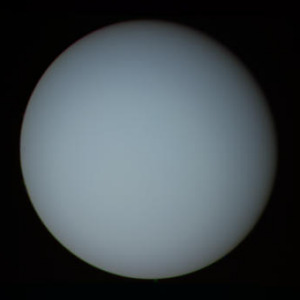
| Uranus. Taken by Voyager 2. Courtesy: NASA/JPL/Caltech |
Uranus
|
| Uranus. Taken by Voyager 2. Courtesy: NASA/JPL/Caltech |
Uranus, the seventh planet from the sun, was named after the ancient Roman god of the sky. He was the father of Saturn and grandfather of Jupiter. Uranus appears as if it has been twisted by some huge hand, spinning on a tipped-over axis. For 42 earth years one pole of this planet is aimed at the sun, while the other pole remains in darkness. Then once the planet has moved halfway around its orbit, the other pole becomes aimed at the sun for just as long. You would think that with the sun aimed at one side for 42 years it would be warmer than the dark side, but just the opposite is true. Voyager 2 scientists have concluded that, for some still unknown reason, the dark pole of Uranus is slightly warmer than the sunlit pole.
The British astronomer Sir William Herschel discovered Uranus in 1781. The first five satellites orbiting Uranus were discovered from 1787 to 1948. The next ten satellites were discovered by the United States space craft Voyager 11 when it flew by Uranus in 1986.
The mean distance between the sun and Uranus is about 1,781,000,000 miles (2,866,900,000 kilometers). That's about 19 times Earth's distance from the sun. If we were to stand on Uranus and look back at the sun we would see it as just a little tiny disk, but it would still be so bright that it would be 1,100 times brighter than a full Moon on Earth.
At Uranus's closest approach to the earth, it is about 1,700,000,000 miles (2,720,000,000 kilometers) away. If we were to send a radio transmission to Uranus and back it would take 2 hours and 45 minutes to go each way.
Uranus has a diameter of 31,570 miles (50,800 kilometers), which is more than four times the diameter of earth.
Uranus takes 17 earth hours to spin on its axis. The large angle of tilt and rapid spin make Uranus appear to roll along in its orbit.
Uranus has a year span longer than some people's life spans. It takes Uranus 30,685 Earth days, or 84 Earth years to complete one of its years.
Very little is known about the surface of Uranus. It is believed by most astronomers that the planet is covered in clouds. Astronomers don't know for sure, but they have estimated that the surface temperature of Uranus is about -357 degrees Farenheit ( -216 degrees Celcius).
Uranus has 15 known satellites. The first one of these to be discovered was Oberon. Oberon was discovered in 1787. It is the second largest satellite that belongs to Uranus, and it is also the farthest away from Uranus.
The last of Uranus's 15 satellites to be discovered was Bianca. Bianca is 36,800 miles (59,200 kilometers) away from Uranus, which makes it about the third closest satellite from Uranus. Bianca's diameter is about 30 miles (50 kilometers). It is next to the smallest satellite orbiting Uranus. The only satellite which is smaller is Cordella. Cordella's diameter measures 25 miles (40 kilometers).
Uranus has at least 11 thin rings surrounding it. These rings are much less bright than those of Saturn. They are made up of countless chunks of an unknown black material. The chunks only measure about 1 yard ( 91 centimeters) in diameter. The rings are always parallel to Uranus's equator.
Fact Sheet |
||
| Planet Name | Uranus | |
| Latin Name/Greek Name | Uranus/Uranos | |
| Symbol |  |
|
| Year Discovered/Discoverer | 1781/Sir William Herschel | |
| Mass | 86.849 x 10 27 g | |
| Volume (Earth = 1) | 52 | |
| Density | 1.30 gm/cm3 | |
| Surface Gravity | 869 cm/s2 | |
| Escape Velocity at Equator | 21.29 km/s | |
| Mean Equatorial Radius | 25,559 km | |
| Albedo (Percentage of light reflected) | .51 | |
| Motion | ||
| Sidereal Rotation Period (Earth Days) | 0.71833 | |
| Rotation Direction | Retrograde | |
| Orbit | ||
| Sidereal Orbit Period (Earth Years) | 83.74740682 | |
| Mean Orbit Velocity | 6.8352 km/s | |
| Orbit Eccentricity | 0.04716771 | |
| Mean Distance (Semimajor Axis) from Sun | 2,870,972,200 km | |
| Inclination of Orbit to Ecliptic | 0.76986 degrees | |
| Inclination of Equator to Orbit | 97.86 degrees | |
| Natural Satellites | Cordelia Ophelia Bianca Cressida Desdemona Juliet Portia Rosalind Belinda Puck Miranda Ariel Umbriel Titania Oberon Caliban (97U1) Sycorax (97U2) 1986U10 |
|
If you do not see frames, click here to go to the frames page.
If you do not want to use frames, click here to go to the non-frames home page
and sitemap.