 |
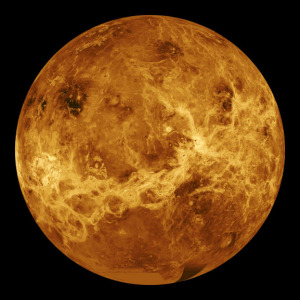
| Venus. Computer generated view taken from Magellan's Imaging Radar. Simulated Color. Courtesy: NASA/JPL/Caltech |
Venus
|
| Venus. Computer generated view taken from Magellan's Imaging Radar. Simulated Color. Courtesy: NASA/JPL/Caltech |
Venus is the second planet from the sun. It is named after the Roman goddess of love and beauty. People once thought that this planet was just as lush and wonderful as earth. But this planet, known as earth's "twin" because of the similarity in size and density, is nothing at all like earth.
Surrounded by clouds of sulfur and acid so thick that radar had to be used to "explore" it, Venus was found to be extremely hot and dry. Any water would boil away instantly because of the 300 degree temperatures.
The atmosphere on Venus is heavier than that of any other planet in our solar system, consisting primarily of carbon dioxide, with small amounts of nitrogen and water vapor. The landscape on this planet includes mountains, canyons, valleys, flat plains, and possibly active volcanoes.
Venus revolves around the sun every 225 earth-days. Its spin is so slow that four earth-months go by between one Venus sunrise and the next. By the time three Venus days have gone by, it has already completed a full swing around the sun. Thus, on Venus, a year is less than two days long. Venus's rotation is retrograde, or " backward," so the sun rises in the west and sets in the east.
Venus is closer to Earth than any other planet, and at its closest approach, it comes as close as 25,000,000 miles away. As Venus travels around the sun different illuminated areas are visible from the earth, making it look as if Venus is changing shape and size. These apparent changes are called phases, and they resemble those of our moon. Venus can be seen near the opposite side of the sun about every 584 days. At this point almost all of its sunlit area is visible. As Venus moves around the sun toward the earth, its sunlit area seems to decrease and its size appears to increase. After about 221 days, you can only see half of the planet from the earth. After another 71 days pass, and Venus nears the same side of the sun as the earth, only a thin sunlit area can be seen.
The mass of Venus is about four-fifths of the mass of Earth. The diameter of Venus is about 7,520 miles, which is about 400 miles smaller than earth's diameter. The force of the gravity on Venus is slightly less than that on Earth, so that something weighing 100 pounds on earth would weigh about 89 pounds on Venus.
Fact Sheet |
||
| Planet Name | Venus | |
| Latin Name/Greek Name | Venus/Aphrodite | |
| Symbol |  |
|
| Year Discovered/Discoverer | N/A | |
| Mass | 4.8690 x 1027g | |
| Volume (Earth = 1) | 0.88 | |
| Density | 5.24 gm/cm3 | |
| Surface Gravity | 887 cm/s2 | |
| Escape Velocity at Equator | 10.36 km/s | |
| Mean Equatorial Radius | 6,051.8 km | |
| Albedo (Percentage of light reflected) | .65 | |
| Mean Temperature at Solid Surface | 730 K | |
| Motion | ||
| Sidereal Rotation Period (Earth Days) | 243.0187 | |
| Rotation Direction | Retrograde | |
| Orbit | ||
| Sidereal Orbit Period (Earth Years) | 0.61518257 | |
| Mean Orbit Velocity | 35.0214 km/s | |
| Orbit Eccentricity | 0.00677323 | |
| Mean Distance (Semimajor Axis) from Sun | 108,208,930 km | |
| Inclination of Orbit to Ecliptic | 3.39471 degrees | |
| Inclination of Equator to Orbit | 177.3 degrees | |
| Natural Satellites | None | |
If you do not see frames, click here to go to the frames page.
If you do not want to use frames, click here to go to the non-frames home page
and sitemap.