 |
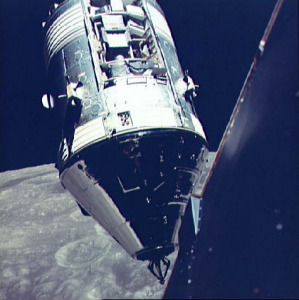
| Apollo 17 Command/Service modules photographed from lunar module in orbit. Source: NASA |
The Apollo Program
|
| Apollo 17 Command/Service modules photographed from lunar module in orbit. Source: NASA |
The Apollo program, started in July 1960, got underway because of a challenge proposed by President John F. Kennedy. He proposed that the United States get a man on the moon before the end of the 1960's. The Apollo program, now considered a success, almost got canceled before it got started.
Apollo 1, the first in a long line of Apollo spacecraft, was expected to encounter problems, but no one could have expected the tragedy that occurred.
On January 27, 1967, during a dress rehearsal for the launch, an explosion occurred in the capsule of the Apollo 1 spacecraft. Even though the crew was protected by their spacesuits from being burned, all three crew members died because of suffocation.
The explosion and the deaths of the crew members had a tremendous effect on the American people. Some even called for a total cancellation of the Apollo program.
The explosion was caused by the insulation on an electrical wire becoming frayed and exposing the wire. When this exposed wire came into contact with the pure oxygen being stored in the capsule, a huge explosion occurred. The crew members who died in this tragedy were Virgil Grissom, Edward White, and Roger Chaffee.
In preparation for the trip to the moon, spacecraft had to be designed that could support life in space for an extended length of time. On October 11,1968, Apollo 7 was launched into space. It was the first manned spacecraft to be launched under the Apollo program.
While in flight, the crew tested all command and service module systems, and captivated the imaginations of people world-wide. The flight itself lasted exactly 260 hours, 8 minutes, and 45 seconds, more than enough time for a spacecraft to travel to the moon and return home.
The Apollo 7 capsule was larger and more comfortable than the earlier Mercury and Gemini capsules. This spaciousness allowed the crew to leave their seats and float around the inside of the cabin. Unused space under the crewmembers' seats was used on later missions for sleeping.
The Apollo 7 spacecraft had three crewmembers: Walter Schirra, Donn Eisele, and Walter Cunningham. Walter Schirra, the command pilot, had already flown aboard the Mercury 8 and Gemini 6 spacecraft, and was the only astronaut that flew for all three missions.
The race for the moon seemed to be growing closer when in September, 1968, the Soviet Union launched the Zond 5. The Zond 5 was the first to successfully attempt a circumlunar flight-with-recovery. After the Zond 5, the U.S. assumed that the Soviet Union would follow it up with a manned mission to orbit the moon. For this reason, the launch of the Apollo 8 mission was bumped up in order to avoid being the second to orbit the moon.
The Apollo 8 spacecraft was launched on December 21, 1968, at 07:21:00 a.m. EST. It broke free from the Earth at a speed of almost 39,000 kilometers/ hour. Apollo 8 entered lunar orbit sixty-nine hours and 15 minutes after takeoff, on Christmas Eve. This marked the first time a manned spacecraft had ever circled the moon. It orbited the moon at an initial altitude of 271 kilometers, with a significant drop from the third orbit to within 96 kilometers of the surface. In all, the Apollo 8 mission succeeded in orbiting the moon 10 times.
During the life of the Apollo program, many phases of testing occurred. The flight of Apollo 9 was one of these.
Launched on March 3,1969, Apollo 9 used a launch vehicle called the Saturn V. This was the same launch vehicle that was used for Apollo 8 and all of the later Apollo missions, except for Apollo 18. While in flight, the mission of the crew was to test the lunar module that they had brought with them. After they had succeeded in doing this, they returned home.
On May 18, 1969, Apollo 10 was launched. Its mission was to carry out the last stages of testing on the lunar equipment before Apollo 11's mission to land on the moon.
During the mission Thomas Stafford and Eugene Cernan boarded the lunar module and while still maintaining lunar orbit, descended down to within 14,447 meters of the surface of the moon, over the Sea of Tranquillity. During the preparation for returning to the command service module, a switch setting failure resulted in violent oscillation on the lunar module. Disaster was avoided, however, by the skillful operation of the module by the two astronauts on board. This near disaster proved the durability and superior performance capability of the lunar module.
Success! The U.S. finally won the race to the moon. The Apollo 11 spacecraft, launched on July 16, 1969, landed on the moon. Apollo 11, manned by Neil Armstrong, Michael Collins, and Edwin Aldrin, was the first manned spacecraft to ever land on the moon.
The location of the landing site was the Sea of Tranquillity. And the occasion was forever marked by commander Neil Armstrong's words as he made his first steps onto the surface, "That's one small step for man, one giant leap for mankind."
Before leaving the moon, the crew of Apollo 11 left a memorial plaque dedicated to the 3 American astronauts (Virgil Grissom, Edward White, Roger Chaffee) and 2 Russian cosmonauts ( Vladimir Komarov, Yuri Gagarin) who died in the course of man's journey to the moon. The plaque reads, "Here Men From Planet Earth First Set Foot Upon The Moon. July 1969 A.D. We Came In Peace For All Mankind." Armstrong and Aldrin were on the surface for 21 hours and 36 minutes, and they returned home with 21 kilograms of moon rock. The Apollo 11 spacecraft was in flight for 195 hours, 18 minutes, and 35 seconds, and the mission itself lasted for 9 days.
On November 14,1969, the Apollo 12 spacecraft was launched. Its lunar module, the Intrepid, landed at the Ocean of Storms. This was the second time in history that man had landed on the moon. The two crewmembers aboard the Intrepid were on the surface for 31 hours and 31 minutes. During this time they took two moon walks, and collected 34.3 kilograms of lunar surface material. They also retrieved equipment left by the unmanned Surveyor 3, which had landed nearly two years earlier. Before returning to Earth, the lunar module's ascent stage was launched back into the moon, and seismometers left behind by the crew recorded its impact.
The Apollo 13 spacecraft, launched on April 11, 1970, was scheduled to land on the moon during its mission, but it never did. 55 hours and 55 minutes after the launch, an oxygen tank in the service module exploded, crippling almost all of the spacecraft's functions, and diminishing electrical and oxygen supply to the command module. Under the guidance of mission control, the crew of Apollo 13 boarded the lunar module (LM) "Aquarius" in order to conserve power, oxygen, and fuel aboard the command module for re-entry into the Earth's atmosphere. To get back to Earth, the crew used the LM's attitude control engine to swing once around the moon and return safely to Earth.
Apollo 14, launched on January 31, 1971, was piloted by Alan Shepard. Alan Shepard was the first American in space aboard the Mercury 3. The other two crewmembers aboard the Apollo 14 were Stuart Roosa and Edgar Mitchell. Shepard and Mitchell landed the lunar module, "Antares," on the moon in the Fra Maura region. They performed 2 moon walks during the 33 hours and 31 minutes that they remained on the moon. They also deployed the ALSEP (Apollo Lunar Surface Experiments Package). While still on the lunar surface, an explosive charge was detonated at a crater rim to induce a man-made moon-quake. Before leaving for home, the crew of the Apollo 14 mission launched the third stage of the Saturn V rocket into the lunar surface, inducing a second seismic event. One year later the seismological equipment left on the moon by Apollo 14 recorded the impact of a meteorite 3 meters in diameter. This impact measured 100 times the magnitude of the impact of the Saturn V rocket.
Apollo 15 was launched on July 26, 1971. The crew of this mission was David Scott, Alfred Worden and James Irwin. Its lunar module, "Falcon," landed in the Hadley-Apennine region near the Apennine Mountains. It was manned by David Scott and James Irwin. These two astronauts aboard the Falcon remained on the lunar surface for 66 hours and 55 minutes. While on the surface, the two astronauts performed 3 EVA's (extra-vehicular activity), and covered a total of 28 kilometers with the LRV (Lunar Roving Vehicle). They also deployed various observational equipment, including the ALSEP, and collected 77 kilograms of moon rock. This was the first time that the LRV was used in a lunar mission.
The Apollo 16 craft was launched on April 16, 1972. It was manned by John Young, Thomas Mattingly, and Charles Duke. The Apollo 16 lunar module, "Orion," manned by John Young and Charles Duke, landed on the surface of the moon in the Coyley Plains.
The astronauts remained on the surface for 71 hours and 2 minutes. During this time they completed 3 EVA's, using the LRV for the second one. In total, the two men covered a total of 27 kilometers on the lunar surface. They also deployed various observational equipment including the ALSEP, and collected 97 kilograms of moon rock. Apollo 16 was recovered on April 27, 1972. It had been in flight for a total of 265 hours, 51 minutes, and 5 seconds.
Apollo 17, launched from Earth on December 7, 1972, was the last of the Apollo missions. Its crew, Eugene Cernan, Ronald Evans, and Harrison Schmitt, was in space for 301 hours, 51 minutes, and 59 seconds. The lunar module, "Challenger," manned by Eugene Cernan and Harrison Schmitt, touched down in the Taurus- Littrow highland region. While Cernan and Harrison were on the surface they completed 3 EVA's, used the LRV to cover 35 kilometers, and collected 110 kilograms of moon rock. All of this, the distance covered over the lunar surface, their lunar surface stay-time (75 hours), and the total mission flight time were all records for the Apollo program.
The Apollo-Soyuz Test Project took place under the terms of a peace treaty agreed upon by the United States and the Soviet Union in 1972. The mission of this project was to test common docking equipment. If both countries used the same docking equipment, one craft could rescue the crew of the other craft in the case of an accident. The use of common equipment could also help both countries to reduce development costs for space missions by allowing them to use the same equipment. The project involved both the United States Apollo 18 spacecraft and the Soviet Union's Soyuz 19 spacecraft.
Soyuz 19 was launched on July 15, 1975, it was followed seven and a half hours later by the Apollo 18 mission. Soyuz 19 was manned by cosmonauts Alexei Leonov and Valeri Kubasov, and Apollo 18 was manned by astronauts Thomas Stafford, Vance Brand, and Donald Slayton. The two spacecrafts docked in orbit two days after being launched. After the docking, the crews changed craft, and carried out several joint experiments. Relations between the two crews were good despite the Cold War going on between the two countries at the time.
If you do not see frames, click here to go to the frames page.
If you do not want to use frames, click here to go to the non-frames home page
and sitemap.