 |
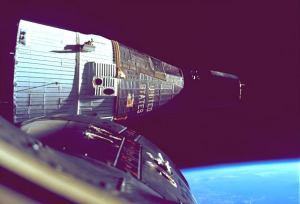
| Gemini Rendezveus. Photographer: Gemini Astronauts; Date: Dec 15, 1965 Source: NASA |
Gemini Program
|
| Gemini Rendezveus. Photographer: Gemini Astronauts; Date: Dec 15, 1965 Source: NASA |
The Gemini program was created for the purpose of teaching astronauts the techniques involved in docking, rendezvous, long-term flight and space-walks.
The Gemini program was named after the sign in the zodiac. In the zodiac, the Gemini sign represented twins. The Gemini program was so named because of its use of the two-person space craft.
The first two Gemini craft were unmanned satellites. The first manned space mission under the Gemini program was the Gemini 3. The Gemini 3 carried two astronauts: Virgil I. Grissom and John W. Young. It was launched from Cape Canaveral on March 23, 1965, and was the first to ever change the direction of its orbit.
The Gemini 4 space craft was launched three months after Gemini 3 on June 3, 1965. It was manned by Edward H. White and James A. McDivitt. While in orbit Edward H. White became the first American to ever perform a space walk.
Gemini 5 was launched on August 21, 1965. It was manned by Gordon Cooper and Charles Conrad. The mission of the Gemini 5 was long-term, manned space flight. It was able to stay in orbit for 190 hours and 55 minutes, despite a malfunction in the spacecraft's fuel cell system.
Gemini 6, launched on December 15, 1965, was manned by Walter Schirra and Thomas Stafford. Gemini 7, manned by Frank Borman and James A. Lovell, was actually launched before Gemini 6 by 12 days. 6 hours after being launched, Gemini 6 spacecraft overtook the previously launched Gemini 7. The two crafts flew in formation, rotating slowly around each other, and stayed this way for 3 orbits around the Earth. At one point the two crafts got as close as 30 cm to each other. Gemini 7 stayed aloft for 330 hours and 35 minutes, and orbited the Earth 206 times. This set a new record for the duration of a space flight.
Gemini 8, launched on March 16, 1966, was manned by Neil A. Armstrong and David R. Scott. It completed the first ever successful docking with the Agena 8 satellite. After docking, the two vehicles began to spin unexpectedly while still joined. Even after undocking, Gemini 8 continued spinning because one of the thrusters on the Gemini 8 wouldn't stop jetting. The Gemini 8 was forced to make an emergency landing in the Pacific Ocean.
Gemini 9, launched on June 3, 1966, was manned by Thomas P. Stafford and Eugene A. Cernan. It was in flight for 72 hours and 21 minutes. While in orbit, Eugene Cernan became the second U.S. astronaut to perform a space walk. It was planned for Cernan to use an AMU (Astronaut Maneuvering Unit) while on his space walk, but due to problems with the equipment Cernan was able to use AMU for only a short time.
Gemini 10 was launched on July 18, 1966. It was manned by astronauts John Young and Michael Collins. Gemini 10 performed the first "double-rendezvous" ever done in space. John Young successfully docked with the upper stages of two Atlas-Agena rockets which were in orbit around the earth. Michael Collins performed a space walk during this flight, and had the same problems with the equipment that Eugene Cernan had during the Gemini 9 mission.
Gemini 11, launched on September 12, 1966, was manned by Charles Conrad and Richard Gordon. They were aloft for 71 hours and 17 minutes. As with the Gemini 10 mission, the Gemini 11 mission entailed rendezvous and docking with an Agena target vehicle, and extra-vehicular activity in order to confirm spacecraft and equipment performance in preparation for the Apollo lunar program already in progress.
The two final astronauts launched with the Gemini program were James A. Lovell and Edwin A. Aldrin on Gemini 12, which was able to finish with almost all of the mission's objectives accomplished.
If you do not see frames, click here to go to the frames page.
If you do not want to use frames, click here to go to the non-frames home page
and sitemap.