 |
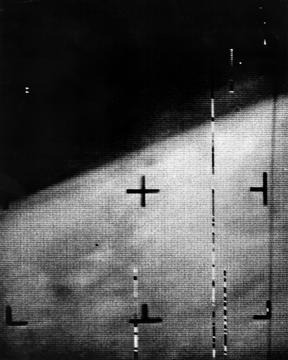
Enhanced Contrast Version of First Mars Photograph Taken by Mariner. Source: Nasa |
Mariner
Mariner 1, launched on July 22, 1962, suffered launch failure. Mariner 2 was launched on August 27, 1962. It was the first U.S. satellite to travel beyond Earth to another planet. On December 14, 1962, Mariner 2 came as close as 34,827 km to Venus, and from there successfully carried out observations. What it found was contrary to the various popular theories about Venus. What it found was that, instead of being covered with jungle or seas of oil, the surface of Venus was really extremely hot and dry. It also found that Venus has no detectable magnetic field. Mariner 2 is still in flight.
Mariner 3, launched on November 5, 1964, was a Mars probe. Unfortunately, launch fairing failure prevented it from performing a Mars flyby. It did, however, engage in research and exploration of the upper atmosphere.
Mariner 4, launched on November 28, 1964, was the first probe to observe Mars from up close. Mariner 4 relayed back images of Mars that showed its surface was full of craters. It also found that Mars has almost no magnetic field. It also has low temperatures and a low atmospheric pressure at the surface.
On October 19, 1967, Mariner 5 flew to within 4,100 km of Venus. While doing so it relayed data back to Earth indicating that Venus had an atmospheric pressure of 75-100 times that of Earth. Mariner 5 is still in flight.
Mariner 6, launched on February 25, 1969, returned 49 far-encounter and 26 near-encounter images of Mars. It also took close-ups from the near encounter phases covering 20 percent of the surface. Mariner 6 also identified the south polar cap of Mars as being composed mostly of carbon dioxide, and it estimated the Martian surface pressure to be between 6 and 7 mb (millibars).
Mariner 7, launched on March 27, 1969, was launched on a direct-ascent trajectory to Mars 31 days after Mariner 6. It returned 126 images of the Martian surface. At its closest approach, Mariner 7 was 3430 km above the surface of Mars.
Mariner 8 suffered launch failure, and Mariner 9 was forced to combine its mission objectives with Mariner 8's.
Mariner 9 was launched on May 30, 1971. Its new mission was global mapping of the Martian surface, including detailed views of Martian volcanoes, Valles Marineris, the polar caps, and the satellites Phobos and Deimos. In addition to completing all this, it provided information on global dust storms.
Mariner 10, launched on November 3, 1973, was the last of the Mariners. While in flight, it performed a flyby of Venus on its way to Mercury, and it sent back the first ever ultraviolet imagery of the planet's thick clouds. Mariner 10 was able to provide a significant amount of new information about Mercury, and helped to dissolve the mystery surrounding this planet. Mariner's decay date was March 24, 1975.
If you do not see frames, click here to go to the frames page.
If you do not want to use frames, click here to go to the non-frames home page
and sitemap.