 |
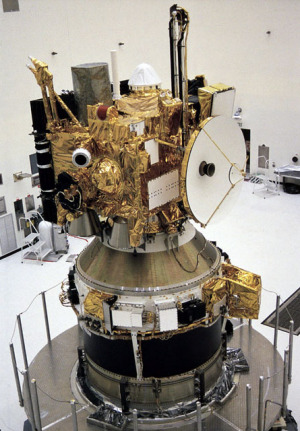
| Mars Observer/Transfer Orbit Stage (TOS) Stacking on Titan III Source: NASA |
Mars Observer
Mars Observer was launched on September 25, 1992. During the Observer's insert burn, contact with the probe was lost. There are many possible causes for the failure such as an explosion when the rocket was ignited because of an oxidizing agent leaking into the propulsion system lines, or faulty electronic circuitry, etc. The Observer's mission was to photograph the Martian surface and observe its weather conditions.
The Mars Global Surveyor, launched on November 7, 1996, formed a set probe with Pathfinder. While the Pathfinder observed the surface of Mars, Surveyor would survey the land and climate of Mars from its orbit. On its way to Mars one of Surveyor's solar panels failed to open, but it was still able to arrive in the Martian orbit on September 12, 1997, as scheduled. However, while aerobraking to settle into orbit, Surveyor used an unexpected amount of fuel, and couldn't enter its planned orbit around Mars until March 1999, one year later than originally planned. During its study of the Martian surface, the Surveyor discovered that Mars has a weak magnetic field. The Mars Global Surveyor is still in operation.
Mars Pathfinder, launched on December 4, 1996, arrived on Mars on July 4, 1997. Pathfinder differed from the earlier Mars probes in that it was smaller and cheaper. Instead of using a soft-landing rocket to cushion the impact, the landing craft used a huge airbag. It was the first space craft to ever use this method. After landing, a six-wheeled rover called Sojourner--named after an American suffragette--drove out of the lander onto the surface. While Sojourner moved around taking rock and soil analysis, the lander took photos of the surrounding area and observed the Martian climate. On September 27, 1997, and on October 7, 1997, the lander's signals ended. It is believed that its malfunction was linked to the minus 70 degree-environment of Mars. The Sojourner was designed to be operational for about one week, and the Lander for about one month, but both were able to keep transmitting information for about three months.
Mars Surveyor 1998's orbiter was launched on December, 1998, and its lander was launched in January or February of 1999. While the orbiter observes the planet's atmosphere, weather and climatic features, the lander will land on Mars and, after releasing a capsule containing two microprobes, will fire its rockets and land somewhere near the Martian planet's southern pole. While on Mars, the lander will use its robotic arm to scoop up soil for analysis and conduct observations on weather and land formation. It will also help to either confirm or deny the belief that ice exists on Mars.
If you do not see frames, click here to go to the frames page.
If you do not want to use frames, click here to go to the non-frames home page
and sitemap.