 |
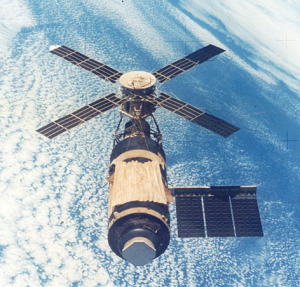
| Skylab Space Station in Orbit. Source: NASA |
Skylab
|
| Skylab Space Station in Orbit. Source: NASA |
The Skylab 1 mission, launched on May 14, 1973, used launch vehicles and spacecraft already developed under the Apollo program to construct a space station much bigger than the Soviet Union's Salyut. The main body was composed of the 3rd stage of the Saturn V rocket. This provided a much larger living space than that of the Soviet Salyut. The plan was for a crew to be launched aboard a Saturn V, and dock with the Skylab for crew transfer. The return trip to Earth would be via the re-entry command module. This would have worked, except that the solar/ meteoroid shield was ripped off during ascent, tearing with it one solar panel wing. This caused the temperature inside the station to jump to 52 degrees centigrade. The station had to be repaired before long- term occupation would be possible.
The Skylab 2 was launched on May 25, 1973. Its crew was Charles Conrad, Paul Weitz, and Joseph Kerwin. The mission was officially designated Skylab 2, because Skylab 1 was the launch of the station, but it was almost universally called Skylab I, using a Roman Numeral. The Skylab facility included a kitchen and showers, and it even had private crew quarters. The first job of the Skylab crew aboard Skylab 2 after docking their Apollo craft with Skylab 1 was to repair the damaged areas of Skylab 1. While performing EVA (extra-vehicular activity) the crew of the Skylab I attached a sunshield to the Skylab 1 body, and repaired the non-deploying solar panel. The astronauts were in flight for 672 hours, and 49 minutes, setting a new space endurance record.
Skylab 3 was launched on July 28, 1973. Its crew, Alan Bean, Owen Garriott, and Jack Lousma, were in flight for 1427 hours, and 9 minutes, setting a new space endurance record. After docking they carried out a series of scientific experiments. The crew of the Skylab III returned to Earth on September 25, 1973.
Skylab 4, launched on November 16, 1973, was the last of the Skylab missions. The crew, Gerald Carr, Edward Gibson, and William Pogue, were in flight for 2017 hours and 16 minutes, during which time they performed a range of scientific experiments. The crew of the Skylab IV returned to Earth on February 4, 1974.
Skylab 1 was supposed to orbit the earth until the 1990's, but due to the effect of the solar wind gradually shifted the craft's orbit closer to the earth's atmosphere, and Skylab 1 fell to the earth over a wide area from the Indian Ocean to southwestern Australia. Skylab's success led to the July, 1975 Apollo-Soyuz Test Project, which was the first-ever joint United States-Soviet mission.
If you do not see frames, click here to go to the frames page.
If you do not want to use frames, click here to go to the non-frames home page
and sitemap.