 |
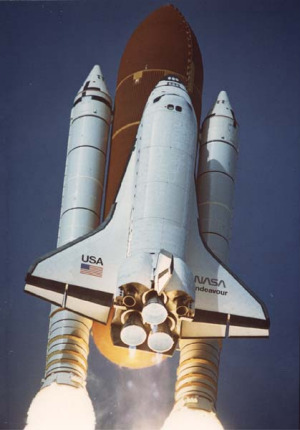
| The Space Shuttle Endeavour in Flight. Source: NASA |
The Space Shuttles
|
| The Space Shuttle Endeavour in Flight. Source: NASA |
The Space Shuttle orbiters in the American fleet are named after pioneering sea vessels. NASA chose the ships which achieved historical significance through discoveries about the world's oceans or the earth itself, and named their shuttles after them. However, the last shuttle, Endeavour, was also selected with consideration for the international nature of the Space Shuttle program. Its name was chosen from the suggestions submitted by school children around the world. There are four shuttles in the American fleet that are currently operational. These are the Columbia, Discovery, Atlantis, and Endeavour.
Columbia, commonly known as OV-102, for Orbiter Vehicle-102, is the oldest Shuttle in the fleet, was the first to fly into earth's orbit in 1981. It was named after the Boston, Massachusetts-based sloop captained by American Robert Gray. The Columbia, piloted by Gray and his crew, maneuvered past the dangerous sandbar at the mouth of a river that extends more than 1,000 miles through what is now southeastern British Columbia, Canada, and the Washington-Oregon border. Columbia's empty weight was 158,289 lbs. at rollout and 178,000 lbs. with the main engines installed.
In 1991, Columbia became the first on-line orbiter to go through the scheduled inspection and retrofit program. It was transported to prime Shuttle contractor Rockwell International's Palmdale, California assembly plant on August 10,1991, and from there it underwent many improvements, including carbon brakes, drag chute, and improved nose wheel steering. The shuttle returned to KSC (Kennedy Space Center) on February 9, 1992, and began processing for its next mission in June of that year.
The Columbia, as of April, 1998, had completed 22 flights, traveled about 86 million miles, completed 3,286 orbits of Earth, and spent 196 days in space. Its next launch is scheduled for September 16, 1999.
Discovery, commonly referred to as OV-103, was the third orbiter to become operational at the Kennedy Space Center. It was named after a ship piloted by British explorer James Cook in the 1770's. During his voyages in the Discovery, Cook discovered the Hawaiian Islands, and explored the coasts of southern Alaska and northwestern Canada. The Discovery had an empty weight of 151,419 lbs. at rollout, and once the main engines were installed, it had a weight of about 171,000 lbs.
Discovery was one of two orbiters that underwent modifications to enable them to carry the Centaur upper stage in the payload bay. These modifications included installing extra plumbing to load and vent Centaur's cryogenic (L02/LH2) propellants, and controls on the aft flight deck for loading and monitoring of the Centaur stage. No flight with the Centaur was ever flown because the risk involved in launching a shuttle with a fueled Centaur upper stage in the payload bay was decided to be too great.
Atlantis, commonly known as OV-104, was the fourth shuttle to become operational at Kennedy Space Center. It was named after the Woods Hole Oceanographic Institute's primary research vessel. The institute was based in Massachusetts, and the vessel whose name was used was operational from 1930 to 1966.
Atlantis had an empty weight of 151,315 lbs. at rollout, and once its main engines had been installed it weighted about 171,000 lbs.
During construction, the amount of man hours was able to be reduced by 49.5 percent. Most of this was attributed to a greater use of thermal protection blankets instead of tiles on the upper orbiter body. While being constructed, NASA decided to have a set of 'structural spares' made to facilitate the repair of an Orbiter if one became damaged. These spare parts consisted of a spare aft-fuselage, mid-fuselage, forward fuselage halves, vertical tail and rudder, wings, elevons and a body flap.
When Atlantis was shipped off to California for upgrades and modifications it had a lot done to it. The modifications performed included a drag chute, new plumbing lines that configured it for extended duration in space, more than 800 new heat and protection tiles and blankets and new insulation for the main landing gear doors. In all, Atlantis spent around 20 months in Palmdale, California, and had 165 modifications done.
Endeavour, commonly known as OV-105, was constructed out of spare parts originally made for the Discovery and Atlantis orbiters. Endeavour is the newest addition to America's four-orbiter fleet. It was named after the first ship commanded by James Cook, the British explorer, navigator and astronomer of the 18th century. On the 18th century Endeavour's maiden voyage in August, 1768, Cook traveled to the South Pacific Ocean. And on a later voyage in 1769, Cook became the first person to fully chart New Zealand. He also surveyed the eastern coast of Australia, navigated the Great Barrier Reef and traveled to Hawaii. To chose this name, a national competition involving students in elementary and secondary schools was held. Once the name had been chosen, it was announced by President George Bush.
The Space Shuttle Endeavour was delivered to Kennedy Space Center in May, 1991. It had been installed with new hardware that was designed to improve and expand the capabilities of the orbiter. This new hardware included a 40-foot diameter drag chute to help reduce rollout distance by 1,000 to 2,000 feet, plumbing and electrical equipment needed to extend the duration of the missions to up to 28 days, advanced general purpose computers, improved navigation systems, enhanced master events controllers and multiplexer-demultiplexers, a solid-state star tracker, improved nose-wheel steering mechanisms and an improved APU (Auxiliary Power Unit) that would provide power for the Shuttle's hydraulic systems. Later, during an 8-month orbiter maintenance down period in California, an external air lock was installed, giving Endeavor the ability to dock with the International Space Station.
If you do not see frames, click here to go to the frames page.
If you do not want to use frames, click here to go to the non-frames home page
and sitemap.